Showing posts with label Energy Solar. Show all posts

Sunday, March 11, 2018

Solar Controller Discussion


Below is a video with a Blue Sky Representative talking about his product, the “Blue Sky SB3000i Solar Boost MPPT Solar Charge Controller”. It is a good review of the product for anyone who is thinking about adding solar to your Van, RV or Home. He covers just about everything in simple English, and all the facts are from the horse's mouth, the manufacturer!

The video is by Jamie, of Enigmatic Nomadics:

Side Note:
Many You-Tube producers when discussing a product, direct you to their own Amazon link, stating that if you use his Amazon link to buy the product, the link will take you directly to the product and also say they make a few pennies off the sale (at no cost to the buyer) to support their video making. That sounds reasonable and it is convenient.

Well, I find few things ever cost me nothing when using a third party to purchase something. I did use Jamie’s Amazon link to take me to the product to check the price of the controller and here’s what I found. (I do not know if this is common for all You-Tube producers).

Pricing of the Blue Sky Controller using three sources:

$313 using Jamie’s Amazon link:

$282 Blue Sky factory direct:

$250 using Amazon direct:


It always pays to shop around:


Sunday, July 17, 2016

200 watts of Solar Panels Provides How Many Amps a Day?

Solar Panel Amps Delivered Every Hour for 12 Hours

There are many questions people new to Solar Systems ask. The most common is how many watts do I need to run a fan, compressor type refrigerator, laptop, some lighting and also how many batteries will I need?

First you need to find out the watt consumption of each device. A simple call to the manufacturers’ customer service will provide that information. Or buy a Kill-a-Watt meter and measure it yourself.

My System:
It’s a simple 200 watt system, two 100 watt panels, similar to what is being used by many van-dwellers and RVers’. The panels are aligned pretty close to perfect to the sun.


The Results:
For test comparison accuracy I used a 750 watt electric heater for a few minutes at a time to maintain a 12.2 volt battery state of discharge between the hours of logging the results.

The chart below shows the measured amps going to the battery on clear sunny Florida day. The chart shows the hour of day and the delivered amps at that hour.

Time of Day:       AMPS Delivered Per One Hour
7:00am                  0.0                 
8:00am                  1.1
9:00am                  1.9
10:00am                4.2
11:00am                8.8
12:00pm                9.7
1:00pm                  12.0
2:00pm                  10.2
3:00pm                  8.1
4:00pm                  6.0
5:00pm                  4.1
6:00pm                  2.0
7:00pm                  0.0

                   68 amps total delivered for the day


Monday, July 11, 2016

Solar Panel Care when on vacation and EMP Damage


I had two questions about my solar panels that needed expert answers to. For the answers, I went directly to the manufacturer of my panels, Grape Solar in California. To get the answers I spoke with their Technical Help, an Electrical Engineer at 1-877-264-1014 for the answers to my questions.

(1)  I plan on traveling, leaving the house empty and unattended for 30-90 days in length multiple times a year. I needed to know what is a safe way to leave the solar system during that time, operating or disconnect the panels?
Grape Solar said no, do not disconnect the panels but instead leave a light load on the system such as a small inverter or a 12-volt night light hooked up directly to the batteries.

(2)  Will solar panels be damaged by an EMP (Electro Magnetic Pulse) event?
Grape Solar said the panels should not be affected by an EMP Event. If not already, ground the frames to a typical 8-foot ground rod driven into the ground. However, the rest of the components connected with long wires will probably be damage! That means the solar charge controller will be damaged. Have a spare in a Faraday Cage/envelope.

Friday, July 1, 2016

Solar Inverter vs Amps Used

All inverters when at idle/standby (not supplying current to a device) draws what’s called a phantom or idle current. This can be an unnecessary drain on your batteries overnight. One way around it is to turn the inverter OFF when not needed, but this can be inconvenient if all lighting or fans you use are 110v.

I have two inverters, both are low-cost, modified sine wave units 87% and 88% efficient purchased from Harbor Freight. One is a 400/800 watt unit and the other is a 1000/2000 watt unit. The 2000 watt is for running a microwave and used only when needed.

Idle current is how much current an inverter draws in a ‘stand by mode’ ready to produce 110volt current for any appliance, fan or lamp that needs inverted power. It’s important to know this amount of current especially if you have a low wattage solar system mounted on an RV or Bug Out Van roof and it’s not possible to align your panels to a perfect angle to capture as much sun energy (watts) as possible. This means you have to be frugal with all the solar power you have available. Turning off the inverter when not needing it will save amps.


For this test, I purchased a load/current meter to verify solar device power consumption:
DROK® Digital Multimeter DC 6.5-100V 20A Voltage Amperage Power Energy Meter DC Volt Amp Tester Gauge Monitor LCD Digital Display with Blue Backlight Measuring Volts Current with Built-in Shunt for $13.99.
Source:

At just $13.99 this is a deal! I’ve seen similar ones at $120.00
It displays battery voltage, amp draw, watt draw and total watt hours consumed also has a built in shunt. Everything is contained in this unit. The display here show the power used with the inverter off.


The meter can be panel mounted. However, I attached 12ga wire and alligator clips to use as a portable test instrument.


Wiring diagram on back side.


Rear view.


The first thing I tested was the idle current of my two inverters and was a little surprised at what I found:

The idle current draw for the smaller 400/800 watt unit is:
0.26 amps (idle current is not specified in the manual or online)

The idle current draw for the larger 1000/2000 watt unit is:
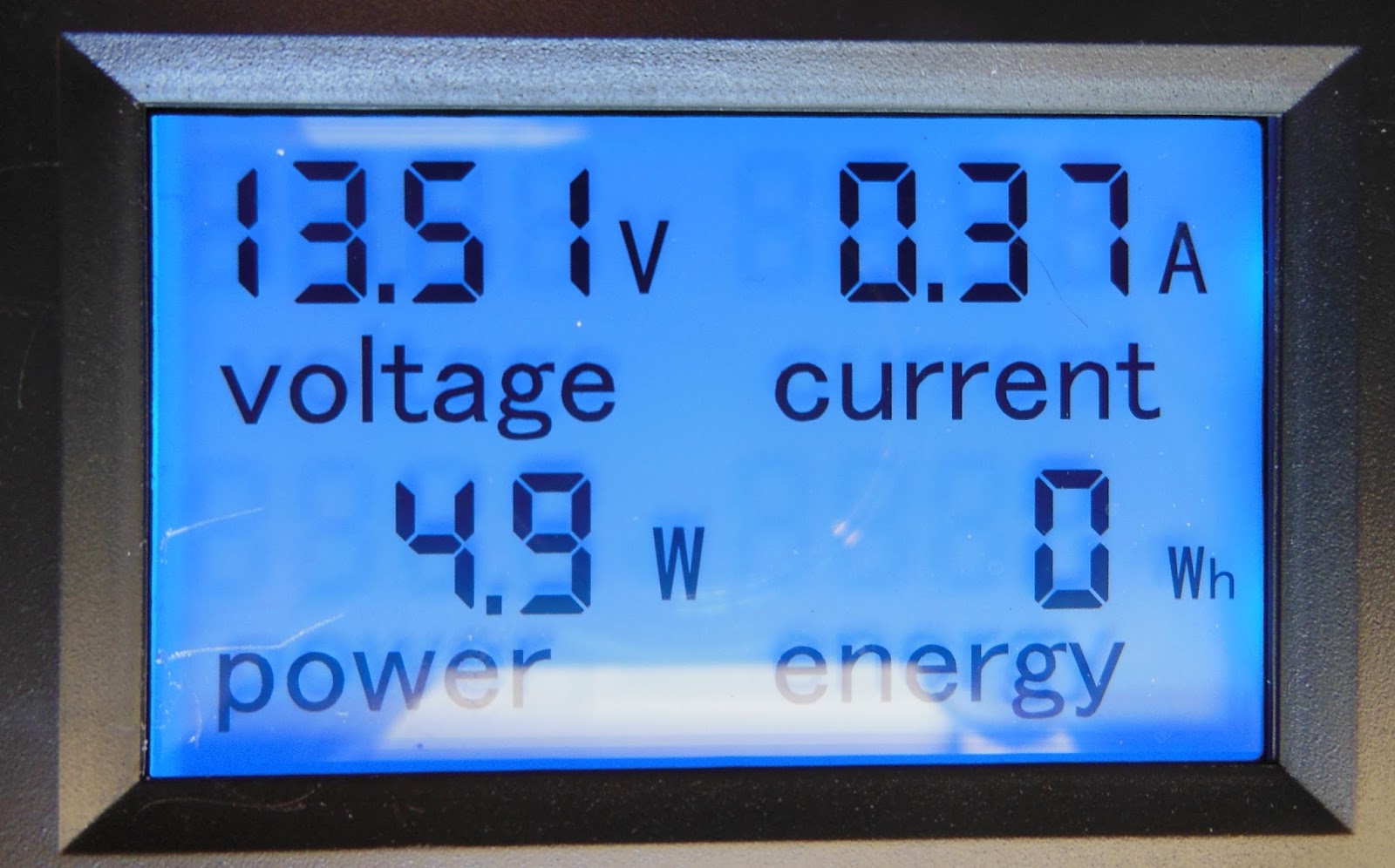
0.37 amps (idle current specified in the manual is 0.8 amps)


The two inverters I own and use:
The 400/800 watt on the left and the 1000/2000 on the right.

Inverter Source:


Inverter test results:
Meter display before attaching either inverter:


Meter display with the 400 watt inverter attached and idling.


Meter display with the 1000 watt inverter attached and idling.


The Voltage reading varies due to small clouds in the area at the time of testing.


What does all this mean?
Let’s use a typical 80 amp hour solar battery. That means the battery can supply 80 amps before it is totally depleted and ruined. Most solar people and battery manufacturers recommend for the longest life from a solar battery is to not discharge more the 20% so in the case of this 12v, 80ah battery you have only “16 amps” to consume before recharging.

If for example:
Using the 1000w inverter that needs 0.37 amps just to idle and you have a charging window from 8:00am until 6:00pm is just 11 hours when the sun can re-charge your system. I have 13 hours of ‘0’ charging time which means 13 x 0.37 = 4.8 amp drain on the battery or approximately 1/3 of the battery’s total usable amps for nothing! Turning off the inverter saves amps for when you need them.

So the summary of this article?
Is simply turn off the inverter when not needed and let the panels replace as much current as possible to the batteries!


Friday, September 18, 2015

Simple PV Solar System

A PV Solar System is one of the most comforting and affordable things a Survivalist/Prepper can have. Just the thought of knowing you have electric power for lighting and communications for years while others are in total darkness is priceless!

A quick history note:
I have been using my PV Solar System for 7½ years non-stop 24/7 and the system works perfectly with almost no attention what so ever. About 1½ years ago I upgraded my panels from the Harbor Freight three, 15-watt panels to, two 100 watt panels, a 1000 watt inverter and two 12v RV/Marine batteries. The purpose was to be able to run a small refrigerator during a grid down situation along with lighting and communication needs.
However, a couple weeks ago we had a very close lightning strike and it caused my controller to fail and subsequently over charged my batteries and destroyed them also. So I have to basically start over except for the PV Panels.

Right now this is my current, low cost, 200-watt system:
It has one 12v deep cycle marine battery, a 30 amp charge controller, two 100 watt solar panels and a 1000 watt inverter. I know that doesn’t sound like a lot of watts, but this system guarantees I will have endless amounts of needed electricity during a grid down event especially when there’s no gas available for the generator.

What do I power with this system?
It provides more than enough electricity to run my kitchen 23 watt flat panel TV, my garage radio, my chargers for “AA” batteries and recharging all my communication radios that have internal battery packs and charge the batteries for all the LED lights I have so at night I’m not living in the dark. 
If I had a couple more batteries and solar panels along with full sun all day at my location I would easily be able to power my 5 cu ft chest style refrigerator that uses 640 watts every 24 hours. How great would that be, cold beer and safe fresh food storage while others are in the dark.


Here’s what my inexpensive system looks like.

The heart of the system:
In the upper right corner is the charge controller, lower left corner the battery, lower center the inverter and upper center a state of charge chart.

On the roof are the two 100 watt PV Panels:
The dish has nothing to do with the system this was just the only place on the roof where because of trees it has a clear alignment to the satellite. The panels have to be there also because this is the only place where they can get 3-4 hours of sun a day. The rest of the day the roof and panels are shaded by trees. Here the panels are just entering the full sun cycle for the next 3 hours then they will be in tree shade the rest of the day.

The 12 volt RV/Marine Deep Cycle Battery:

Battery specs.

The controller:
It shows the state of charge, battery volts or the array voltage coming into the controller.

The Inverter:
1000 watt continuous with a 2000 watt surge capability.  It easily handles a 5 cu ft refrigerator or freezer.

Important Information Sources:
Please pay close attention to the wire/cable sizes used in your system. Too small a gauge can overheat and burn your house down.
Probably the best source of small PV system wire size information is at this link: https://handybobsolar.wordpress.com/ and a retailer is http://www.backwoodssolar.com/


Bottom Line:
It doesn’t get much simpler than this. It’s hard to find a reason not to have a small system even if just 100 watts for emergencies. This system is also a very good educational tool for your family and your neighborhood kids.

Cost of this system:
$260 - 2-100-watt panels (Home Depot)(for a starter system just one panel is fine)
$81 – Battery (Walmart)
$39 - Charge Controller (Amazon)
$45 – Inverter (Harbor Freight)
--------------------
$425 – Total Cost (or $295 with one PV panel)

And before someone tells me that I’ll never see a payback from this system! This system is not about payback or economy or free electricity, it’s about personal security and a supply of electrical convenience in terrible times. Can’t put a value on that!


Tuesday, September 15, 2015

PV Solar System: Lightning and EMP?

A few weeks back we had a typical Florida thunderstorm including lots of typical lightning. During the storm, there was one bolt/flash of lightning with a simultaneous, wall rattling BOOM which told me it was very close to home like less than 50 yards. Nothing appeared to be damaged from that one so all was thought to be good.

It wasn’t until a couple days later I noticed my solar charge controller display was ‘nervous’ where the display wasn’t steady like normal. The voltage display digits would constantly bounce around from .1 to .5 volts!

After a couple weeks nothing changed. I checked the battery water level and it was extremely low, like almost empty in EVERY CELL. The water has been boiled out of BOTH my RV/Marine 12v batteries, very odd for my system. In the 7½ years I’ve had this system running 24/7 I have added water only one time several years ago and it was a very small amount, actually didn’t need any, just felt guilty that it must need some! The controller has worked perfectly all that time.

So what happened to what has been a bullet proof solar system????
I’m guessing the nearby lightning damaged the controllers upper charge limit of 14.4volts and with that limit not working it overcharge the batteries and subsequently boiled out the water. There was a diagnostic feature in the controller that told me the controller was set properly to 14.4 volts. So to test the controller I reset the float charge to 14.2 volts, replaced all the water and watched to see if the batteries and controller could attain and maintain a ‘float charge level’. It never did reach a float level mode just kept on charging with all the power the panels delivered and boiled the water out again. Obviously the controllers float charge limiting function was toast and so were my two, 15-month-old RV/Marine batteries.

In summary:
I have since replaced the batteries and controller and all is well now. I would have to guess that if a CME or an EMP pulse were to strike a solar system that uses a controller component it will probably be killed. Maybe because there're only two electronic items in the solar system I need to have a backup Controller and Inverter stored in a Faraday Cage? That may be very smart as I feel EMP would be the weapon of choice of our adversaries.


Saturday, July 18, 2015

Solar 12 volt power can burn your house down!

Over at Backwoods Home I found this story written by their writer Electrical Engineer, Jeff Yago. It’s worth a look and a reminder that 12 volt solar systems are not idiot proof. They can be a fire hazard if installed improperly.

The story here:


Wednesday, April 1, 2015

Solar Panels, Keep Them Clean

Where I live we have thousands of acres of pine forest, it's a crop grown for the paper industry. Every spring they produce a yellow pollen in great amounts, it leaves behind a yellow dusting on your cars, outdoor furniture, virtually everything outside.

I looked at the panels on my roof and sure enough I could see the pollen dust on them. So I got the scrub brush on the extension pole, a step ladder and the garden hose ready. Before the cleaning began I noted the amp output then immediately cleaned the panels and again noted the amp reading after cleaning. To my surprise there was an 11% increase in the amp output! Quite a gain for simply hosing and brushing the panels.

Truth is, solar panels are very sensitive devices, their precise alignment to the sun, free of the slightest shadows such as the hour that my satellite dish casts a small shadow on them and now dust accumulation has a bigger impact on output then many would think.


The panels on the roof that were cleaned.
(I have a very small window of direct sun because of all the trees around me so the panels are mounted in the best position to make the most of the available few hours of sun.)


Wednesday, December 31, 2014

Watts Used and Wasted at My Home

December 2014

I find that I've become overloaded with modern convenience appliances and devices throughout the home, probably the same as you. I do have a small Solar PV System (200 watts of panels) that powers my garage lights, garage radio and the kitchen 18 inch flat panel TV. The PV System always made me aware and wonder about used and wasted watts throughout the rest of my home.

So this month I went on a hunt of all my devices and appliances just to see how much power I consume or waste and where I could eliminate the waste. Maybe you can learn something here from my experience which I feel is pretty normal for today's homes and apartments.

The testing instrument used, a Kill-A-Watt, P3 model. This is a handy little meter relatively inexpensive ($19.00 at Amazon), easy to use and necessary if you use Solar power or just curious where your wasted power is. It took a little effort but some of the findings were surprising!

Note; the 1 watt readings are the minimum this meter will display, it could actually be 1/2 watt


Here's the power usage/waste discovered at my home:

Refrigerator 23.1 cu. ft, on: 122 watts
Refrigerator 23.1 cu. ft, 24 hours on/off cycle: 990 watts
Refrigerator 23.1 cu. ft, standby: 2 watts

Freezer chest, 5.0 cu. ft., 60f environment temp, on: 72 watts
Freezer chest, 5.0 cu. ft., 60f environment temp, 24 hours on/off cycle: 540 watts
Freezer chest, 5.0 cu. ft., 60f environment temp, standby: 1 watt

B&D coffee maker, 12 cup brew cycle: 400 watts
B&D coffee maker, 12 cup, standby: 1 watt

Keurig coffee maker, Single cup: 20 watts
Keurig coffee maker, Single cup, standby/off: 0 watts

Lap Top computer Gateway, on: 11 watts
Lap Top computer Gateway, sleep: 7 watts
Lap Top computer Gateway, standby: 1 watt
Laptop extension speakers, standby: 1 watt

Lap Top computer Dell, on: 14 watts
Lap Top computer Dell, sleep: 1 watt
Lap Top computer Dell, standby: 1 watt

12 volt power supply, HAM, listening on: 25 watts
12 volt power supply, CB, listening on: 15 watts
12 volt power supply, on, idle: 10 watts

Microwave oven, on: 1,633 watts
Microwave oven, standby: 3 watts

Phone kitchen (1) wall bug: 1 watt

Phone extension (1) wall bug: 1 watt

Cell phone (mine) wall bug charging: 5 watts
Cell phone (mine) wall bug idle: 1 watt

Cell phone (hers) wall bug charging: 5 watts
Cell phone (hers) wall bug idle: 1 watt

I-Pad wall bug charging: 5 watts
I-Pad wall bug idle: 1 watt

Printer, printing: 14 watts
Printer, standby: 4 watts

Computer Router, wall bug: 7 watts

Satellite TV receiver kitchen, on: 34 watts
Satellite TV receiver kitchen, standby: 34 watts

Satellite TV receiver bedroom, on: 34 watts
Satellite TV receiver bedroom, standby: 34 watts

TV main 48 inch flat panel, on: 120 watts
TV main 48 inch flat panel, standby: 1 watt

TV kitchen 18 inch flat panel, on: 22 watts
TV kitchen 18 inch flat panel, standby: 1 watt

TV master bedroom 18 inch flat panel, on: 25 watts
TV master bedroom 18 inch flat panel, standby: 1 watt

TV computer room 18 inch flat panel, on: 24 watts
TV computer room 18 inch flat panel, standby: 1 watts

TV room lamp, on: 11 watts
TV room lamp, 24 hour timer on/off cycle: 44 watts

Water softener, one softening cycle: 40
Water softener wall bug, standby: 1 watt

Garage door opener, open & close cycle: 400 watts
Garage door opener, standby: 4 watts

Hummel display cabinet light, on: 18 watts
Hummel display cabinet light, 24 hour timer on/off cycle: 126 watts

--------------------------------------------------------------------------------------
Summary:
I find it interesting that both the satellite receivers never go into a sleep mode, they're 'on' all the time with a combined 68 watts constant draw 24/7 = 40.8kw a month!

With the exception of the two bathrooms all lights are CFL's.
I have been looking for CFL replacement fixtures for those two rooms because there are 24 decorator type incandescent bulbs between the two rooms. Each bulb is 40 watts = 960 watts total. Glad they're not rooms where a lot of time is spent!

The other concern are the amount of wall bugs in use. I personally feel these are all potential fire hazards because when you manufacture for the lowest cost something has to be compromised in the design.

As for the satellite receivers we are planning to dump satellite TV all together. I have the basic HBO/Showtime and forced to have another bundle package of 200 channels of pure garbage for $139 a month. Most of the time the TV is on for background noise because we I spend a lot of time on the computers and she has been downloading movies and books to her I-Pad and watching or reading those. Satellite is just too expensive for what we watch, plus every time a rain storm comes the signal goes dead, just when we need the local weather reports the most. Then there's a land line that's needed, $25 a month, and the only reason we have it is for the satellite receivers to check on us or in case we ever wanted to download a pay per view which we don't. The major news programs are pure junk today and not worth watching/listening to there opinions. Then there's the cost of the 68 watts of power every hour I have to pay for.

I'm investigating TV options. I do have a regular antenna so I can receive broadcast signals, so now just need to figure out things like ROKU, HULU, CHROME Cast and several others to see what the charges will actually be and how useful they are. If anyone has experience with these please feel free to let me know what you use and the costs.


For now I needed to review these findings and try to come up with solutions to rid myself of the wasted watts. Obviously if I were to go 100% solar I would have to use power strips so I control what's on and on only when needed.

Tuesday, April 15, 2014

Simple Low Cost "Portable" Solar PV System


Since upgrading from my 45 watt Harbor Freight system that ran flawlessly for 6 years to my now 200 watt system I decided to make the 45 watt system portable and totally self-contained. The reason is if I have to 'bug out' I can take the system with and keep my "AA" batteries for night lighting, AM/FM Shortwave and two way radios charged and operational if in a grid-down situation.

Two years ago the wiring connection to the PV Cells leaked water and shorted out completely one of the three 15 watt panels rendering that one useless. If you install your own system be certain water can not infiltrate the cell area under the glass through the electrical connecting box on the back side of the panel. So the bottom line is, I have just two 15 watt panels equaling 30 watts of charging power. This is plenty for recharging "AA" batteries for radios, battery powered lights or power tool batteries.

This project was less than $40 for the new charge controller and connectors. I had an old but still functional car battery. That's it the total cost!

If I wanted to make a brand new system I'd buy a 100 watt panel from Home Depot and the total cost of a very powerful 100 watt system would be under $200.

This is a very simple project that anyone can do.

Here's how I converted my old panels into a portable system.
The charge controller is less than $20 and as you can see very small. It is rated for 7 amps it can handle up to a 105 watt panel.


The polarized connectors I used for the connections.

  
Rear view of the panels


Close up of the panel wire showing how I used epoxy to prevent ripping the wires out of the panel connector box


All wires connected and ready to work. The alligator clips attach to the battery. The 12v socket next to them is where I plug in my 12v extension cord.

  
The 12 foot extension cord I made with two 12v sockets to power the battery chargers and/or radios.


Side view of working panels leaning against my van.


The panels are putting out 17.5 volts.


Tuesday, October 1, 2013

Solar Panels Arrived

The solar panels arrived yesterday 9-30-13 by UPS, 10 days after ordering. The boxes were beat up and looked like I’d have some broken glass inside but they were fine. Panel size: 40.8 x 20.7 x 1.38, Weight: 16.3 lbs. each. First impression is these are a good quality panel and well worth the price of $149.00 each, delivered free.

The protective cardboard shipping sheet that was on top of the glass.

An edge view of the cardboard shows it is ½ inch thick honeycomb structure.


Here’s what the cells look like. They are actually black but the flash of the camera makes them show up blue.

The rear side of the panels.


Panel Label.


Panel connection box and pig tails. Users have no access to the panels connection box just the pig tail connector.


I wanted to test the voltage of the panels because if they were bad I could send them back right away. So I leaned them against the windshield to get some sun on them. Don’t make fun of my paint job, typical of GM. A new paint job will happen after the panels are installed. My must do list is getting too large and just trying to keep up is wearing me out!

The open circuit voltage spec’s are 22.0 volts.
My reading was 20.6 volts however it was a hazy sky and the panels were not angle optimized towards the sun. I have no doubt they will perform to their specifications.


I had to order the mating “MC4” power cable connectors from Amazon ($24.00).
Now I need to figure out how to mount the panels to the roof…

More to come!


Sunday, September 22, 2013

Solar Panels at Home Depot?


Just thought I’d pass this along if you are planning on setting up your first solar power system or going to add more panels to an existing one. When walking through HD I have never seen any kind of solar panels or solar equipment at HD, just thought they didn’t handle it.

I don’t recall why I searched the Home Depot web site for solar panels but it must have been because of one of those annoying animated side bar ads that forced my attention to cancel it. Anyway, I went to their site and was surprised at what they offer and the pricing.

I immediately purchased two, 100 watt, 5.42 amps, 18.5v panels for $149.00 each and they will deliver them to my home or to the store for free! And yes they will be delivered to my home! I'll post photo's when the panels arrive.

Check them out:

Grape Solar 100-Watt Monocrystalline PV Solar Panel, 10 year limited product warranty on materials and workmanship.25 year warranty on >80% power output and 10 year warranty on >90% power output.